

Interview vol.1
tomorka/ kawamoto

"Something that asserts something
Rather,
It's something that's right there."
tomorka/ kawamoto kohei
Interview & photo MUYA

Hello.
We meet often, but I hope to see you today.
Hello. Thank you as always. I look forward to working with you.
Please introduce yourself again.
My name is Kohei Kawamoto from tomorka, a company that manufactures shoes and leather products in Tanabe City, Wakayama Prefecture.

When did you start making shoes and leather items?
I wanted to make shoes since I was a student, so after graduating from high school I enrolled in a shoe school. Working with leather, I started making things around me out of leather.
I saw this in an interview somewhere, but when he had a rash and his shoes didn't fit anymore, his mother said to him,
Was it something like, "Why not just make it yourself?" that got you started?
That's right. When I was 14, my mother said to me, "If you're having so much trouble with shoes, why don't you become a shoemaker yourself in the future?" and for some reason I took her seriously and decided I wanted to make shoes! (laughs)
From there, did you become obsessed?
At first, I took apart shoes I no longer wore and studied from books.
So when I was in high school, there was a shoe fitter's shop on my way to school, and I stopped by on my way home to talk to him, and I realized that the most important thing about shoes is your feet.
I enrolled in a vocational school that has a department in orthopedic shoemaking, which involves making shoes for medical purposes to treat foot problems.
What happens next?
After working at a shoe repair company and a shoe manufacturer, at the age of 24 I started making shoes under the name tomorka at my parents' home in Takasago City, Hyogo Prefecture, and occasionally held solo exhibitions.
When I was 25, I moved to Kobe and started making shoes while helping out at a leather shop.

What is the origin of the name tomorka?
I had always had this idea of creating things that are constantly being sought after, and I thought that this was myself, so I came up with a name that was a slight play on my surname backwards, with the image of myself back to back, something that is me but not myself.
This is the first time I've heard of that name.
So, if you find something that interests you, you might also make something other than leather?
I would like to be able to face the tasks I am given properly and do what I enjoy without being bound by any particular form.

You're from Hyogo Prefecture, but how old were you when you came to Wakayama Prefecture?
I moved to Wakayama when I was 27 years old.
Why did you choose the rural village of Ryujin in Wakayama Prefecture?
When I was a child, I used to spend my long holidays in Tanabe City, Wakayama Prefecture, where my grandparents lived, and my memories of that time made me suddenly want to live there.
Are your grandparents still dragon gods?
My grandparents' house is in Oota, where my 90-year-old grandfather still lives alone. I went to visit him this morning and he looked healthy.
Ryujin is further into the mountains and I had never been there before, but the vacant house that was introduced to me was just the right size for living and making things, so I decided to try making things there.
How was it actually living there?
I moved here feeling like I was being called to this place, so I decided to take advantage of the opportunity to not have any unnecessary desires and instead focus on what I need to do now.
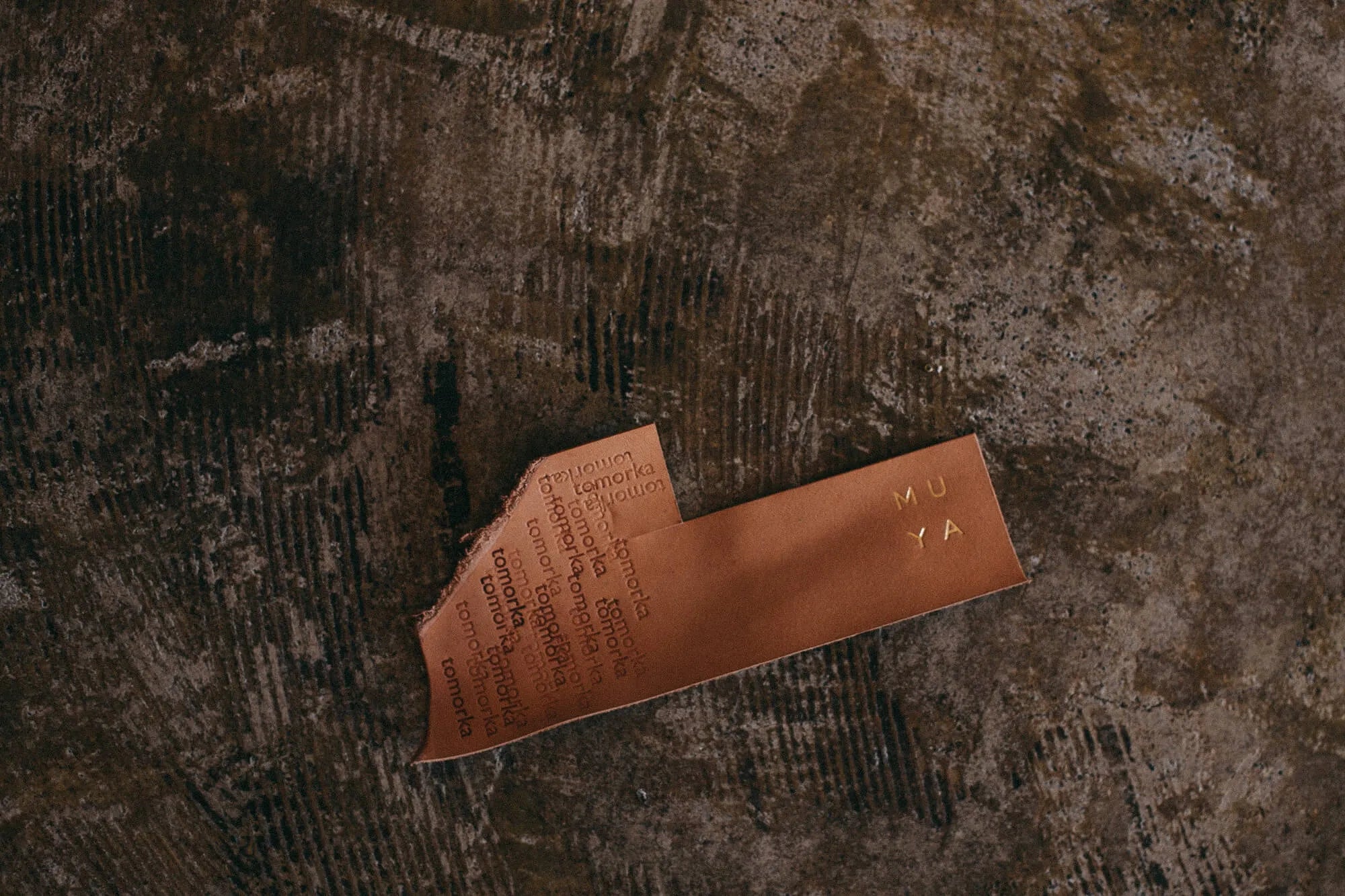
Did you come to our store because your cousin asked you?
That's right. Two or three months after I moved to Wakayama, my mother's cousin took me to MUYA's store in Tomita, saying that I wanted to make things in Wakayama.
In terms of living and lifestyle, I also started making things independently in 2014,
For the first two or three years, I couldn't eat at all, but were you not worried about that?
At first, I was worried that I couldn't make a living just by making things, but I just enjoyed making things so much that I didn't really think about the future.
However, one day, when I watched Takeshi Kitano's "Kids Return" and saw the comedy duo of the two main characters and their classmates,
In order to continue doing what I enjoy, I decided to do each and every task I was given and what I needed to do properly. That hasn't changed.
I understand. If you look closely, the setting of the manzai is the same as when we did it in high school.
Sometimes it's not well received at all.
But as the days go by, little by little, the content and quality change, and eventually the place becomes packed with customers...
Well, that's exactly it.
I just want to watch it again, so I'll watch it again.
Has the things you want to create (make) changed between when you were in Kobe and now (living in the countryside)?
The theme of the move was to confront daily life, so I think the things I made changed to focus on being close to life and everyday life.
Is getting married a big factor?
Seeing my wife approach her work with a sincere belief in what she has done up until now makes me want to face the challenges in front of me every day.
It's a bit eye-watering
It happens quickly (laughs).

This time, my wife wanted shoes that could be worn both formally and casually, so we decided to make original shoes. At first, we asked for slip-on shoes, but
All I could think about was how to give shape to the images and thoughts that were given to me in a simpler way.
Above all, I was glad to get a glimpse of how the two of them create their products and to be able to experience it.
In the end, it took me more than a year to complete the project, from the very simple design to adding tassels (decorations), so I'm sorry about that (laughs).
I'm sorry it took so long to make this.
Specifically, what material?
The upper, sole and core are made of naturally tanned leather.
The more you wear them, the more the leather will conform to the shape and movement of your feet, giving you a feeling that the shoe is enveloping your entire foot.
I haven't heard much about pigskin, but I wonder if it's actually used a lot?
In the case of shoes, it is often used on the lining (inside of the shoe).
Cowhide is also commonly used, but we use pigskin because it is soft on the feet and has good breathability.

As for the shape, it does look like a neat silhouette.
As we talked, I chose something with a comfortable, roomy fit and a clean silhouette, just as you mentioned, so that you can wear it in a variety of situations.
There are many different shapes of wooden shoe lasts that form the base of our shoes, but we choose ones that are not affected by changes in fashion or values.
It may sound a bit exaggerated, but I want people to wear shoes that allow them to face themselves properly, no matter what era they are in.
What's so great about handmade shoes?
I'm sorry, I've been thinking about it for a while, but I can't come up with anything that I can put into words.
That's a good answer. Is there anything that you value?
In all aspects, including materials, patterns, stitching, and molding, we place emphasis on creating shoes that fit your feet better the more you wear them.
After that, I care about the mood.
It's not something that asserts anything, but something that is just there.
It's something that's right there. I can relate.
I once wrote something similar for an exhibition catalog, titled "White Rice at a Chinese Restaurant" (laughs).
"We don't want to be a popular food like fried rice, ramen or gyoza, or any other Chinese dish out there, but we want to be something that doesn't belong to those categories, but is definitely there. MUYA's products are unremarkable and ordinary.
It does not belong to anything or try to become anything, it is nothing but what is there."
I think that's what I wrote.
White rice at a Chinese restaurant (lol) is so familiar and touching. I've heard some great stories.
In the end, it was something I was very satisfied with.
Thank you. I'm honored.
I will continue to consult with you on various matters.
Let's do our best in Wakayama!
We look forward to your continued support. Thank you very much!

